
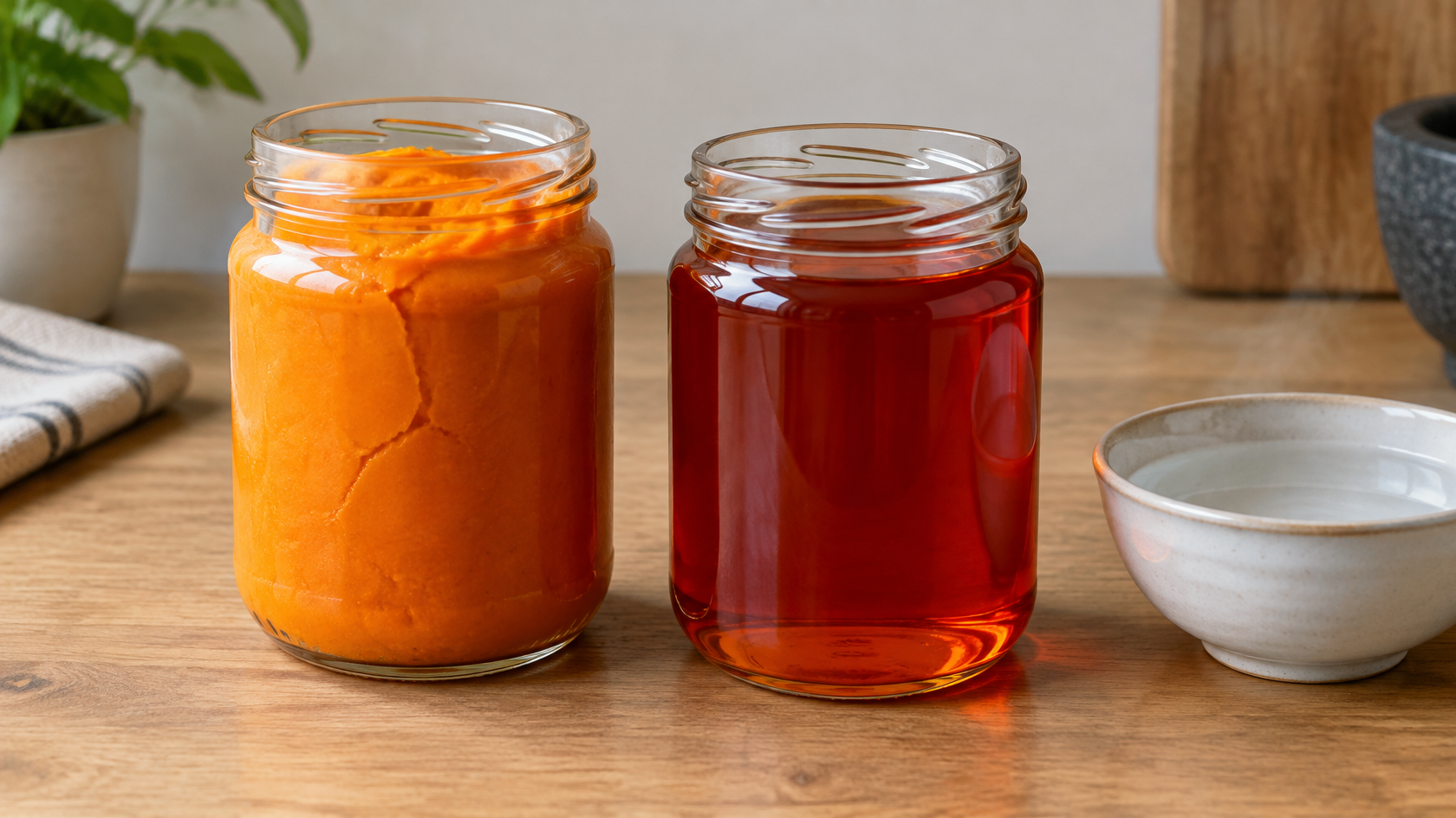
Quick answer: Palm oil goes solid in the UK because it melts at around 34 to 39°C, and British homes are usually far cooler than that. Measured melting points for palm oil cluster around 35 to 37°C, while UK living rooms in winter often sit between 11 and 21°C. A bottle that thickens, sets or separates in your cupboard is normal, and it is actually a good sign that the oil has not been blended with cheaper liquid oils. OlaPantry’s advice is simple: a warm water bath makes it pourable again in minutes.
If you have ever bought a bottle of palm oil in summer and opened it in December to find a thick, half-set block, you are not alone. It is a very common question, and it usually comes with a worry attached: has something gone wrong with the oil?
Nothing has gone wrong. Palm oil is simply a different kind of fat from the sunflower or rapeseed oil most people keep by the hob. In this guide I’ll explain why palm oil is solid at British room temperature, what its melting point actually is, why it separates into layers, and how to make it pourable again without damaging it.
Olayinka runs OlaPantry, a UK-registered online African food store operating under Olakin Limited, Company Number 16909792, verifiable on the Companies House registry. We sell 100% natural, undiluted Nigerian palm oil, packed to UK food standards and traceable by batch number. This guide is a practical checklist for spotting fake or adulterated palm oil before you buy. It covers smell, colour, texture, labels and seller registration, with what to look for at each step.
Want palm oil you never have to second-guess? Shop OlaPantry’s natural Nigerian palm oil and get properly labelled, batch-traceable oil delivered anywhere in the UK, ready for your next pot of egusi.
Why is palm oil solid at room temperature?
Palm oil is solid or semi-solid at room temperature because roughly half of its fat is saturated, and saturated fats have high melting points. Its overall melting point sits well above the temperature of a typical British home, so in the UK it spends most of the year partly set.
UK palm oil producer M.P. Evans gives a full breakdown on its page about the composition of palm oil. It lists saturated fatty acids at 48g per 100g and unsaturated fatty acids at 46g per 100g. That balance is very different from oils that stay liquid in the fridge.
Palm oil is also not a single fat. It is a natural mixture of fats that each melt at different temperatures. That is why it does not switch from liquid to solid at one exact point. Instead, it softens and firms gradually as the temperature changes, like butter.
What is the melting point of palm oil?
The melting point of palm oil is around 35 to 37°C, with a typical range of about 34 to 39°C. The exact figure varies a little from batch to batch because palm oil is a natural product.
Scientists usually measure fats using the “slip melting point”, which is the temperature at which a set sample starts to melt and turn clear. M.P. Evans gives a slip melting point of 36.7°C for crude and refined palm oil, with a range of 33.9 to 39.2°C. A laboratory study published in the PMC research archive, which tested palm-based reference samples across several labs, arrived at a consensus value of 35.6°C for palm oil.
Here is how that compares with other fats you might have at home, using figures from the Engineering ToolBox table of oil melting points:
| Fat or oil | Melting point (°C) | State in a typical UK kitchen |
|---|---|---|
| Palm oil | 35 | Semi-solid or solid |
| Butter | 32 to 35 | Solid |
| Cocoa butter | 34 | Solid |
| Coconut oil | 25 | Solid most of the year |
| Palm kernel oil | 24 | Solid most of the year |
| Olive oil | minus 6 | Liquid |
| Rapeseed oil | minus 10 | Liquid |
| Sunflower oil | minus 17 | Liquid |
So palm oil behaves much more like butter than like the bottle of sunflower oil next to it. Nobody is surprised when butter is firm on the worktop. Palm oil follows the same rules.
How warm is a typical British home?
A typical British home is somewhere between the mid-teens and the low 20s°C, which is well over 10°C below palm oil’s melting point. Even in a well-heated house, the oil will not fully melt.
A 2024 study in the journal Energy and Buildings measured indoor temperatures in UK homes during the winter of 2023. Across nine homes, average living room temperatures ranged from 11 to 20°C, and four of the homes averaged between 11 and 16°C. The authors also reviewed earlier UK studies, which reported average daily indoor temperatures of about 17.5 to 21.6°C.
Kitchen cupboards, pantries and utility rooms are often cooler still, especially against an outside wall. Put those numbers next to a melting point of around 35°C and the answer is obvious. In a British home, palm oil is always below its melting point. The only question is how firm it gets.
It is the same oil in Lagos or Accra. It is simply colder here. That is also why a bottle can arrive from us looking partly set during the colder months, especially after a night in a delivery van. The temperature has changed, not the oil, and a short warm bath brings it straight back.
Why does palm oil separate into layers?
Palm oil separates into layers because its liquid and solid fats melt at very different temperatures. As the bottle cools, the high-melting fats set and sink to the bottom as a cloudy or solid layer, while the low-melting fats stay liquid and clear on top.
The two parts even have names. When palm oil is separated industrially, the liquid part is called palm olein and the solid part is called palm stearin. M.P. Evans gives palm olein a slip melting point of 19.2 to 23.5°C and palm stearin 46.6 to 53.8°C.
That explains exactly what you see in a bottle on a mild day. At around 20°C, the olein-type fats are close to their melting point and can stay partly liquid, while the stearin-type fats are more than 25°C below theirs and set firmly. The result is a clear red layer over a thicker, paler sediment.
Give the bottle a warm bath and a shake, and the layers mix back together. Nothing has been lost or spoiled.
Does solid palm oil mean it has been adulterated?
No. Solid or semi-solid palm oil in a cold kitchen is a sign that the oil is behaving the way pure palm oil should. If anything, the warning sign is the opposite: a “palm oil” that stays thin and runny all through a British winter.
Look back at the table. Sunflower oil melts at minus 17°C and rapeseed oil at minus 10°C. If a seller has stretched palm oil with a cheaper liquid oil, the blend will set less firmly, or not at all, in your cupboard. A bottle that thickens in December is reassuring, not worrying.
That said, texture alone cannot prove an oil is genuine, and it cannot detect illegal dyes. We explain what “undiluted” and “no colouring” really mean in our guide to 100% natural Nigerian palm oil. The most reliable check is a proper label from a registered food business. Every OlaPantry bottle carries its origin, best-before date and batch number, as listed on our food safety page. OlaPantry is run by OLAKIN LIMITED, company number 16909792, and our food business is registered with Huntingdonshire District Council and Cambridgeshire County Council under reference KHE1HR-5D8PNK-N7HDBD. The full details are on our about page.
How do you melt solid palm oil safely?
The safest way to melt solid palm oil is to stand the closed bottle in a bowl of hot tap water for 10 to 15 minutes, then shake it gently. The water only needs to be comfortably warmer than the oil’s melting range of roughly 34 to 39°C, so there is no need for boiling water.
Follow these steps:
- Check the cap. Make sure the lid is screwed on tightly so no water gets in.
- Fill a bowl with hot tap water. Hot from the tap is enough. Avoid water straight from the kettle, which can soften or warp thin plastic bottles.
- Stand the bottle in the water. Let it sit for 10 to 15 minutes, topping up the hot water if it cools.
- Shake gently. Mix the clear and cloudy layers back together.
- Pour what you need. Return the bottle to a cool, dark cupboard.
| Method | Safe? | Notes |
|---|---|---|
| Warm water bath | Yes, best option | Gentle and even, around 10 to 15 minutes |
| Scooping straight into the pot | Yes | Semi-solid oil melts in seconds over heat |
| Leaving near a radiator or boiler | No | Repeated warming and cooling speeds up staleness |
| Microwaving the bottle | No | Uneven heating and risk to plastic bottles |
| Standing it on the hob | No | Too hot, and a fire risk near open flames |
For everyday cooking, you often do not need to melt the bottle at all. A clean, dry spoon of semi-solid palm oil dropped into a warm pot melts almost instantly.
Does melting and re-setting damage palm oil?
Occasional melting and re-setting does not damage palm oil. The fats simply change state and change back. What does shorten its life is keeping it somewhere that warms and cools repeatedly every day, such as next to the cooker or on a sunny windowsill, because heat and light speed up staleness in any oil.
The practical rule is simple. Warm the bottle only when you need to pour from it, and store it somewhere cool and dark the rest of the time. If you buy a 5L size, decant a week’s worth into a smaller bottle and warm only that.
Where should you store palm oil in a British home?
The best place to store palm oil in a British home is a cool, dark kitchen cupboard away from the hob and the boiler. It will be semi-solid there for most of the year, and that is fine. There is no need to refrigerate it, which only makes it set harder.
We cover storage spots, shelf life and the signs of stale oil in our complete palm oil buying and storage guide. The short version: tight cap, clean spoon, cool cupboard, and go by the best-before date on the label.
The bottom line
Palm oil goes solid in the UK because its melting point, around 35 to 37°C, is far above the 11 to 21°C of a typical British home. Partly set oil and cloudy layers at the bottom of the bottle are normal, and they are a sign of pure palm oil rather than a problem. A 10 to 15 minute warm water bath brings it back to a pourable liquid whenever you need it.
Our natural Nigerian red palm oil comes in 1L, 2L and 5L bottles from £5.99, and it will set in your cupboard just as it should. When you are ready to stock up, head to the OlaPantry shop.