
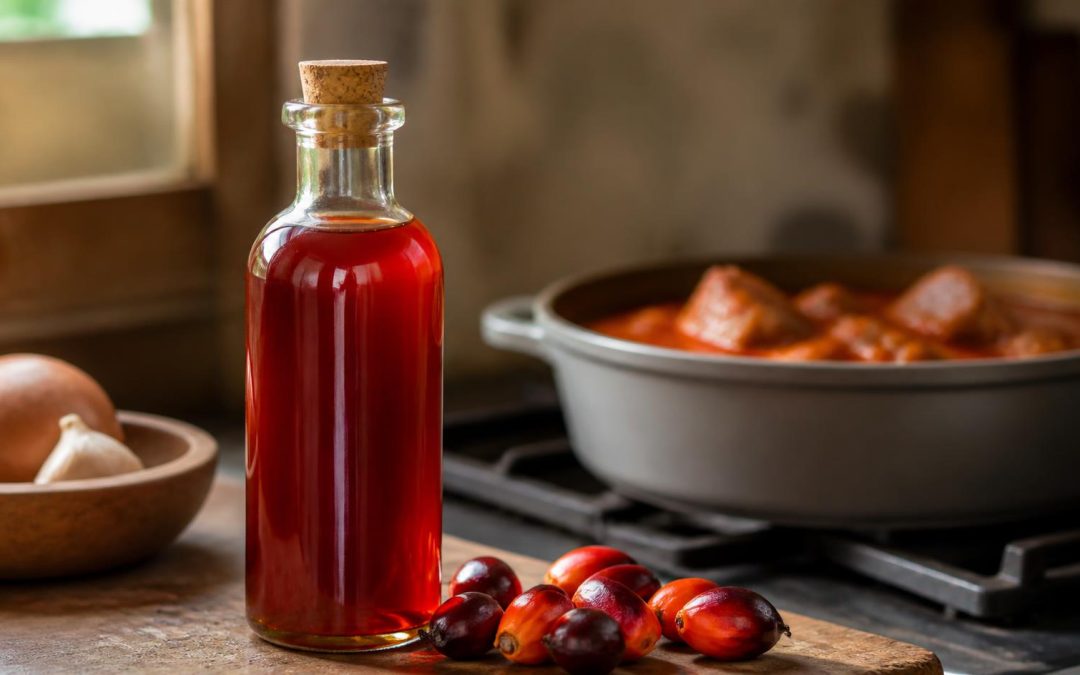
Quick answer: Yes, you can buy genuine Nigerian palm oil in the UK. Real, unrefined red palm oil has a deep orange-red colour and an earthy aroma, and it turns partly solid at normal British room temperature. At OlaPantry we sell 100% natural, undiluted Nigerian palm oil in 1L, 2L and 5L bottles, packed to UK food standards and delivered anywhere in the UK.
If you cook Nigerian food in Britain, you already know the problem. Palm oil is the base of so many dishes, from egusi and efo riro to ofada stew, yet the bottle you pick up in a shop can be thin, oddly bright or flat in flavour. You end up wondering what is actually inside it.
We started OlaPantry to fix that for our own kitchen first. This guide covers everything we have learned: where Nigerian palm oil comes from, how it is made, how to check its quality, how to store it through a British winter, which size makes sense for your household, and how much to use in the dishes you cook every week. If you just want a bottle now, our natural Nigerian palm oil is available in three sizes.
What is Nigerian palm oil and where does it come from?
Nigerian palm oil is the red cooking oil pressed from the fleshy pulp of the oil palm fruit, grown and processed in Nigeria. In Yoruba it is simply called epo pupa, meaning red oil. It is the everyday cooking fat of southern Nigeria and much of West Africa, and it gives dishes like egusi soup their colour and depth.
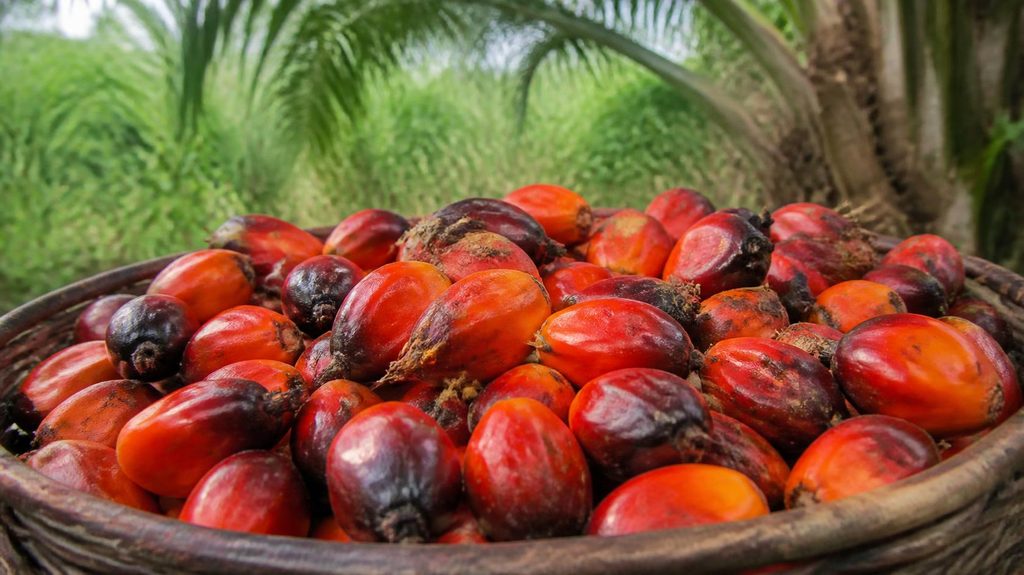
The tree behind it is Elaeis guineensis, the African oil palm. According to its Wikipedia entry on Elaeis guineensis, the species is native to west and southwest Africa, in the area between Angola and The Gambia. Its fruit is reddish, about the size of a large plum, and grows in heavy bunches weighing between 5 and 30kg.
Each fruit gives two different oils, and it helps to know the difference:
- Palm oil comes from the soft outer pulp (the mesocarp). This is the red oil we cook with.
- Palm kernel oil comes from the hard seed in the middle. It is pale, has a different fat profile, and is used mainly in processed foods and soap.
So when we talk about Nigerian palm oil at OlaPantry, we always mean the red oil from the pulp, never kernel oil.
Nigeria is still a major producer. The palm oil overview on Wikipedia puts Nigerian output at 1.5 million tonnes in 2023 to 2024, out of global production of 77.3 million tonnes, with Indonesia alone accounting for 57%. Most of the world’s supply is industrial. Nigeria’s is not. The Nigerian government has said that smallholder farmers produce over 80% of the country’s palm oil, which is why so much of it is still made in small batches using traditional methods.
How is traditional Nigerian palm oil made?
Traditional palm oil is made by boiling ripe palm fruit, pounding it to release the oil, then skimming and heating the oil until the water is gone. Nothing is added along the way. The yield is modest: for every 100kg of fruit bunches, typically 22kg of palm oil can be extracted, according to the oil palm figures cited above.
The small-scale process used across southern Nigeria usually runs like this:
- Harvest. Ripe fruit bunches are cut from the palm. Ripeness matters, because underripe fruit gives less oil and a weaker colour.
- Loosen and strip. The bunches are left for a few days so the fruitlets come away easily, then the fruitlets are separated from the stalks.
- Boil. The fruitlets are boiled until the pulp softens.
- Pound. The soft fruit is pounded or milled to break the pulp away from the nuts and release the oil.
- Separate. Water is added to the mash. The oil floats to the top and is skimmed off, while the fibre and nuts are removed.
- Clarify. The skimmed oil is heated gently to drive off the remaining water, then left to settle and strained.
Larger mills follow the same logic with machinery: sterilising, threshing, pressing and clarifying. What both have in common is that the result is crude, unrefined red oil. It has not been bleached or deodorised, so it keeps its natural colour, smell and flavour.
What does “100% natural” and “undiluted” actually mean?
When we describe our oil as 100% natural and undiluted, we mean three specific things. It has not been blended with cheaper vegetable oil to stretch it. It has no added colouring of any kind. And it has not been refined, so the carotenes that make it red are still there. If any of those three were not true, the label would have to say so, and we would not sell it.
What is the difference between red palm oil and refined palm oil?
Red palm oil is unrefined and keeps its natural carotenes, while refined palm oil is bleached and deodorised until it is pale and almost tasteless. Wikipedia’s palm oil overview notes that red palm oil is rich in carotenes, which give it a dark red colour, while refined, bleached and deodorised (RBD) palm oil does not contain carotenes. For Nigerian cooking, only the red kind will do.
| Red (unrefined) palm oil | Refined (RBD) palm oil | |
|---|---|---|
| Colour | Deep orange to red | Pale yellow to white |
| Carotenes | Present, which is what makes it red | Removed during refining |
| Aroma | Earthy, nutty, slightly fruity | Almost none |
| Flavour in food | Distinctive, rich | Neutral |
| Processing | Pressed and clarified only | Refined, bleached and deodorised |
| Typical use | Egusi, efo riro, ofada stew, native jollof | Margarine, biscuits, snacks, frying fat |
| Where you see it | African grocers and specialist shops | Ingredient lists on processed food |
This is why the palm oil in a packet of biscuits has nothing in common with the bottle in your kitchen cupboard. The same fruit goes in, but refining strips out the colour and the taste that Nigerian dishes depend on.
There is one more product people confuse with both: banga, or palm nut concentrate. Banga is made from the whole pulp, not just the extracted oil, and is used for banga soup and ofe akwu. It is a different ingredient, and you cannot swap it one for one with palm oil.
How can you tell if palm oil is genuine or adulterated?
The most reliable sign of genuine palm oil is a properly labelled bottle from a registered UK food business, because no kitchen test can prove an oil is free from illegal dyes. Colour, smell and texture help you spot poor oil, but they cannot catch everything. That is the honest answer, and it is worth understanding why.
Why are Sudan dyes a concern with palm oil?
Sudan dyes are industrial red dyes that are banned in food. Guidance from the Food Standards Agency, published on NI Business Info’s Sudan dyes page, explains that they are used legally in shoe polish, floor polish, solvents and waxes, and that some are carcinogenic. The same guidance names palm oil among the foods where they have been used illegally, and states that since 2003 all palm oil imports have had to come with test certificates.
This is not a theoretical risk. In April 2015 the FSA recalled unlabelled Ghanaian palm oil sold by a cash and carry in London after it was found to contain Sudan IV, as reported in Food Manufacture’s recall coverage. The oil came in plain plastic containers of 1, 2.5 and 5 litres, with no label at all. That detail matters. An unlabelled bottle gives you no name, no origin, no batch number and nobody accountable.
What should you check before you buy?
| Check | What good palm oil looks like | Warning signs |
|---|---|---|
| Colour | Deep orange-red, slightly translucent when warm | Unnaturally bright, almost neon red |
| Smell | Earthy and nutty | Sour, soapy or chemical |
| Texture in the cold | Thickens or partly sets below room temperature | Stays thin and runny in a cold kitchen |
| Label | Product name, origin, best-before date, batch number | No label, or a handwritten one |
| Seller | Registered UK food business you can contact | No business details, cash only, no address |
A runny oil in a cold British kitchen is a useful clue, because pure palm oil should start to set. It often points to blending with a cheaper liquid oil.
On our side, every product we sell carries its name, ingredients, allergen information, storage guidance, country of origin, best-before date and a batch number, as set out on our food safety and compliance page. Batch numbers mean any bottle can be traced back to its source.
Why does palm oil go solid in the UK, and how should you store it?
Palm oil goes solid in the UK because it melts at around 35°C, far warmer than a British kitchen. The Engineering ToolBox melting point table lists palm oil at 35°C, compared with 25°C for coconut oil and minus 6°C for olive oil. So a bottle that pours freely in Lagos will thicken, separate or set in Huntingdon, especially from October to March.
This is completely normal, and it is actually a good sign. A partly solid bottle is behaving the way pure palm oil should. You may also see a lighter, cloudy layer settle at the bottom while the top stays liquid. That is just the fats with higher melting points setting first.
How do you make solid palm oil liquid again?
Stand the closed bottle in a bowl of hot tap water for 10 to 15 minutes, then give it a gentle shake. Top up the hot water if needed. Avoid three things:
- Putting a plastic bottle in the microwave.
- Standing it directly on a hob or radiator.
- Using boiling water from the kettle, which can warp thin plastic.
If you only need a few spoonfuls, scoop the semi-solid oil straight into the pot. It melts within seconds once it hits the heat.
Where is the best place to store palm oil?
A cool, dark cupboard away from the cooker is the best place for palm oil. Light, heat and air are what make any oil go stale, so the aim is to limit all three.
| Storage spot | Suitable? | Why |
|---|---|---|
| Kitchen cupboard away from the hob | Yes, best option | Dark, steady temperature |
| Pantry or utility room | Yes | Cool and dark, oil will set more firmly |
| Worktop by a sunny window | No | Light and warmth speed up staleness |
| Next to the cooker or boiler | No | Repeated heating and cooling |
| Fridge | Not needed | Oil sets hard and is awkward to use |
Three habits make a real difference. Keep the cap screwed on tight. Use a clean, dry spoon, because water and food crumbs shorten shelf life. And go by the best-before date printed on the label rather than guessing. If the oil ever smells sour or soapy instead of earthy, it has gone stale and should not be used.
Which size of palm oil should you buy: 1L, 2L or 5L?
Most households cooking Nigerian food once or twice a week get the best balance from the 2L bottle, while the 5L suits big families, batch cooks and anyone catering for parties. The 1L is ideal if you are trying palm oil for the first time or cook African dishes only now and then. Prices start at £5.99 for 1 litre, and larger sizes work out cheaper per litre.
To make the choice concrete, we worked it out using a typical family-size pot of soup or stew, which takes around 100 to 150ml of palm oil. Your own recipes may use more or less, so treat this as a guide.
| Size | Approx. family-size pots | Best for | How long it might last |
|---|---|---|---|
| 1L | 7 to 10 | First-time buyers, couples, occasional cooking | 2 months at one pot a week |
| 2L | 13 to 20 | Families cooking Nigerian food weekly | 3 to 4 months at one pot a week |
| 5L | 33 to 50 | Large families, batch cooking, parties, small caterers | Several months, or one big celebration |
Before you go for the 5L, think about storage. A big container needs a cool cupboard with space, and it is opened more often, so good habits matter more. Some customers buy a 5L and decant a week’s worth into a small bottle, which keeps the main container sealed and cool.
We deliver every size across the UK by Royal Mail. Orders are processed within 1 to 2 working days and standard delivery takes 2 to 4 working days, as explained in our UK delivery policy. We do not ship outside the UK at the moment.
How do you cook with Nigerian palm oil?
You cook with Nigerian palm oil by heating it gently as the base of a soup, stew or sauce, then building your other ingredients on top. It is a flavour ingredient as much as a cooking fat, so it is rarely swapped for vegetable oil in traditional recipes. Medium heat is the rule. Unrefined oils smoke sooner than refined ones, and the smoke point table on Wikipedia lists 235°C only for fractionated palm oil, which is a processed product. Burnt red oil tastes bitter, so keep the flame moderate unless a recipe says otherwise.
How much palm oil do classic Nigerian dishes need?
These are our usual starting amounts for a pot that serves 4 to 6 people. Adjust to taste. Some families like their egusi glistening, others prefer it lighter.
| Dish | Role of palm oil | Typical amount (serves 4 to 6) |
|---|---|---|
| Egusi soup | Fries the ground egusi and carries the flavour | 120 to 180ml |
| Efo riro | Base for the pepper mix and iru | 100 to 150ml |
| Ofada stew (ayamase) | Bleached first, then fries the green pepper sauce | 250 to 400ml |
| Native jollof (palm oil rice) | Colours and flavours the rice | 80 to 120ml |
| Asaro (yam porridge) | Gives the porridge its colour and richness | 60 to 100ml |
| Ewa agoyin sauce | Fried slowly with onions and dried pepper | 200 to 300ml |
| Red red (Ghanaian beans) | Base for the onion and tomato sauce | 80 to 120ml |
What is bleached palm oil, and is it safe to do at home?
Bleached palm oil is red oil heated until the colour fades to pale gold, which gives ofada stew and ewa agoyin sauce their smoky, deep flavour. It can be done safely at home, but it needs care. It produces heavy smoke, so open the windows, switch on the extractor, and expect the smoke alarm to complain. Use a heavy pot with a lid nearby, never leave it unattended, and never add water to hot oil. If the smoke turns thick and dark rather than wispy, turn off the heat.
Can you use palm oil if you are new to Nigerian food?
Yes, and it is easier than people think. Start with a dish where palm oil is a supporting flavour rather than the star, such as native jollof or red red. Use a little less than the recipe suggests the first time. Once you know the taste, egusi soup and efo riro are the natural next steps, and they introduce the other pantry staples that make Nigerian food what it is: crayfish, iru, ponmo and stockfish.
What is in a tablespoon of palm oil?
A tablespoon of palm oil contains about 120 calories and 13.6g of fat, of which roughly 6.7g is saturated. The calorie and fat figures come from the FatSecret nutrition listing, and the saturated figure is our own calculation using the 49% saturated fat share given on Wikipedia’s palm oil page.
| Per 1 tablespoon | Amount |
|---|---|
| Energy | 120 kcal |
| Total fat | 13.6g |
| Saturated fat (approx.) | 6.7g |
| Carbohydrate | 0g |
| Protein | 0g |
We will not make health claims about palm oil, and we are wary of anyone who does. What we can tell you is how it fits the UK guidance. The NHS guide to different fats says men should not eat more than 30g of saturated fat a day and women no more than 20g, and it lists palm oil among the foods high in saturated fat. So one tablespoon is roughly a third of a woman’s daily limit and just under a quarter of a man’s. Shared across a family pot of soup, each portion carries much less. Like any cooking fat, it is about the amount you use.
Is Nigerian palm oil sustainable?
Nigerian palm oil comes from a very different system to the industrial plantations most people picture when they hear about palm oil and deforestation. Most of the world’s palm oil comes from large estates in Southeast Asia, with Indonesia producing 57% of global supply. In Nigeria, smallholders produce over 80% of the national crop, often from palms grown on family land and processed locally.
That does not make every bottle automatically sustainable, and we would rather be straight with you about it. The main global certification scheme is run by the Roundtable on Sustainable Palm Oil, founded in 2004, which now has over 6,200 member organisations and certifies sustainable palm oil against environmental and social criteria. Small Nigerian producers are rarely part of certification schemes like this. What we can do is buy traditionally produced oil, keep our sourcing traceable through batch numbers, and tell you honestly where it comes from.
Where can you buy Nigerian palm oil in the UK?
You can buy Nigerian palm oil in the UK from African grocers, some large supermarkets and specialist online shops such as OlaPantry. The right choice depends on what you value most: convenience, price or knowing exactly what is in the bottle.
| Where to buy | Pros | Things to check |
|---|---|---|
| Large supermarkets | Convenient, clearly labelled | Often refined or blended, small range, origin not always Nigerian |
| Local African grocers | Wide choice, you can see the oil | Labelling varies, some bottles are unlabelled or repacked |
| Specialist online shops | Delivered to your door, clear product information | Delivery charges, check the business is registered |
| Market traders and informal sellers | Can be cheap | Often no label, no batch number, no recourse if something is wrong |
Whichever you choose, the checks from earlier still apply: a full label, a batch number, and a seller whose details you can verify.
Who is behind OlaPantry, and how is it registered?
OlaPantry is a trading name of OLAKIN LIMITED, a private company registered in the United Kingdom under company number 16909792, with its registered office at 71 to 75 Shelton Street, Covent Garden, London WC2H 9JQ. We run the business from Huntingdonshire in Cambridgeshire.
Our food business is registered with the local authorities responsible for food safety in our area:
- Huntingdonshire District Council (Environmental Health), for food hygiene
- Cambridgeshire County Council (Trading Standards), for food standards
- Food business registration reference: KHE1HR-5D8PNK-N7HDBD
Everyone handling our food has completed Level 2 Food Safety and Hygiene training or equivalent, and we work in line with the Food Safety Act 1990 and the Food Hygiene (England) Regulations 2013. You can read more about the people and story behind the brand on our about OlaPantry page.
We say all this for a simple reason. After reading about unlabelled oil and illegal dyes, you should be able to check who you are buying from. Every detail above can be verified.
How do you order from OlaPantry?
You can order online through our website, or message us on WhatsApp or Instagram (@olapantry) if you prefer to chat first. Our phone line and contact form are on our contact page, and we answer Monday to Friday, 10am to 6pm. If an order ever arrives damaged or incorrect, let us know within 48 hours with your order number and a photo, and we will arrange a replacement or refund under our refunds and returns policy.
What else do people ask about Nigerian palm oil?
Is Nigerian palm oil the same as red palm oil?
Yes. Nigerian palm oil is a type of red palm oil. “Red palm oil” describes any unrefined palm oil that keeps its natural colour, while “Nigerian” tells you where it was produced. Red palm oil from other countries can differ slightly in flavour and processing.
Is palm oil vegan?
Yes. Palm oil is a plant oil pressed from fruit, with no animal ingredients, so it is suitable for vegan and vegetarian cooking. Many Nigerian dishes that use it also include fish or meat, but the oil itself is fully plant based.
What does Nigerian palm oil taste like?
Good Nigerian palm oil tastes earthy, slightly nutty and gently savoury, with a fruity note that some people compare to carrot or pumpkin. It is not sweet and it is not bitter. On its own it can seem strong, but once it is cooked with onions, peppers and crayfish it becomes the warm, rounded background flavour that makes a Nigerian stew taste like home. If your palm oil tastes sharp, soapy or burnt, something has gone wrong with either the oil or the heat.
Can you mix palm oil with vegetable oil when cooking?
Yes. Plenty of home cooks in the UK use half palm oil and half vegetable oil in stews to lighten the flavour, especially when cooking for children or for friends trying Nigerian food for the first time. It works well in tomato-based stews and fried rice. For egusi soup, efo riro and ofada stew, though, we would stick to palm oil alone, because its flavour is the point of those dishes.
How can you tell how old a bottle of palm oil is?
Check the best-before date and the batch number on the label. A properly labelled bottle should show both, and the batch number lets the seller trace exactly when and where it was packed. If a bottle has neither, you have no way of knowing its age, which is one more reason to avoid unlabelled oil. Once opened, let your nose guide you: fresh oil smells earthy, while stale oil smells sour or like old crayons.
Why is there sediment at the bottom of my palm oil?
A little sediment or a cloudy lower layer is normal in traditionally produced palm oil. It is usually the heavier fats that set first in cool temperatures, plus fine natural particles from the fruit. Warm the bottle in hot water and shake it to mix everything back together.
Can you freeze palm oil?
You can, but there is no need. Palm oil keeps well in a cool, dark cupboard until its best-before date, and freezing just makes it harder to use. If you buy the 5L size, decanting smaller amounts is more practical than freezing.
Does OlaPantry deliver palm oil outside the UK?
No. OlaPantry currently delivers within the United Kingdom only, by Royal Mail, to addresses in England, Scotland, Wales and Northern Ireland.
Ready to cook with the real thing?
Good Nigerian palm oil should be red, earthy, properly labelled and traceable to a business you can check. That is the standard we hold ourselves to at OlaPantry, from the farm to your cupboard. When you are ready to stock up, browse the OlaPantry shop and choose the size that suits your kitchen.