
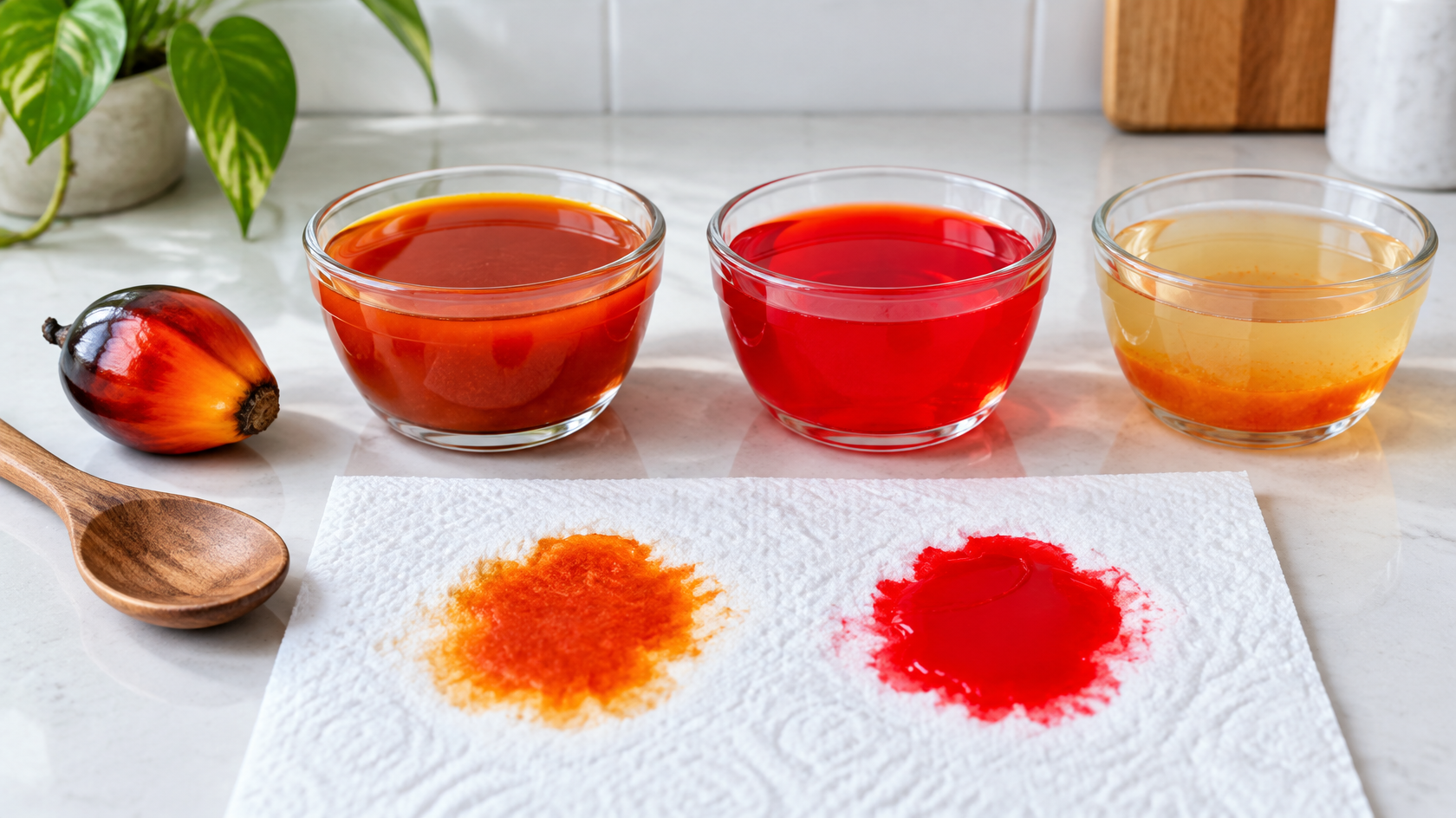
Quick answer: You can spot many fake or adulterated palm oils by checking five things: the smell, the colour, how the oil behaves in the cold, the label, and whether the seller is a registered food business. Real palm oil smells earthy, is a natural orange-red, and thickens in a British kitchen. No home test can prove an oil is free from illegal dyes, though, so the strongest protection is buying from a registered seller like OlaPantry, with full labelling and a batch number on every bottle.
Most palm oil sold in the UK is exactly what it says it is. But “most” is not “all”, and palm oil has a long record of being stretched with cheaper oils or coloured to look richer than it is. If you cook with it every week, it is worth knowing what to look for.
In this guide I’ll explain what “fake” palm oil actually means, how common adulteration really is, and give you a practical checklist to use before you buy.
What does fake or adulterated palm oil mean?
Fake or adulterated palm oil is oil that has been changed or misrepresented to make it cheaper to produce or more attractive to buy. It usually takes one of four forms:
- Diluted oil: real palm oil blended with cheaper vegetable oil to bulk it out.
- Dyed oil: poor-quality oil coloured with industrial dyes to make it look deep red and fresh.
- Stale oil: old or badly stored oil sold as if it were fresh.
- Unlabelled or repacked oil: oil decanted into plain bottles with no origin, date or batch number, so nobody can say what it is or where it came from.
The dyed kind is the most serious. Food Standards Agency guidance published on NI Business Info’s page on Sudan dyes explains that Sudan dyes are used legally in shoe and floor polish, solvents and waxes, but are banned in food because some are carcinogenic. The same guidance names palm oil among the foods where industrial dyes have been used illegally.
How common is palm oil adulteration?
Palm oil adulteration is not widespread in regulated markets, but it is common enough to take seriously. Testing in both Ghana and Canada has found Sudan dyes in a small share of samples.
| Where | What was tested | What was found |
|---|---|---|
| Ghana, 2023 | About 444 palm oil samples from 114 market sites | Around 6.7% contaminated; 93 of 114 sites free of adulteration |
| Canada, 2020 to 2021 | 32 imported red palm oil samples from retail | 1 sample (3.1%) contained Sudan IV at 15.6 ppm |
| Canada, 2019 to 2020 | 72 imported red palm oil samples | 1 sample contained Sudan IV at 47.5 ppm |
The Ghana figures come from the Ghana Food and Drugs Authority, as reported in GBC’s coverage of the FDA findings, which described the 2023 results as a significant improvement on 2022. The Canadian figures come from the Canadian Food Inspection Agency’s survey of non-permitted colours in red palm oil, where the positive sample led to a recall and destruction of the product.
In the UK, the FSA guidance states that since 2003 all palm oil imports have had to be accompanied by test certificates showing they are free from Sudan dyes. That control works best when oil comes through proper import channels and is sold by a business that can trace it.
What should you check before you buy palm oil?
Before you buy, check the smell, colour, texture, residue, label and seller. No single check is proof on its own, but together they filter out most poor or suspicious oil.
| Check | What genuine palm oil looks like | Warning signs |
|---|---|---|
| Smell | Earthy, nutty, slightly fruity | Sour, soapy, rancid or chemical |
| Colour | Natural deep orange to red | Unusually bright, almost neon red |
| Texture in the cold | Thickens or partly sets in a cool kitchen | Stays thin and runny all winter |
| Residue | Settles as a paler, cloudy layer at the bottom | Gritty sediment, dirt or water droplets |
| Label | Name, ingredients, origin, best-before date, batch number | No label, handwritten label or no batch number |
| Seller | Registered business with a name, address and contact details | No business name, cash or DM only, no address |
Smell. Open the bottle if you can. Real palm oil has a warm, earthy smell. A sour or soapy note suggests the oil is stale, and a sharp chemical smell is a reason to walk away.
Colour. Natural palm oil gets its red from the fruit’s carotenes, so it is a deep orange-red. Be wary of oil that looks unnaturally vivid, especially if it is also thin.
Texture. Pure palm oil melts at around 35°C, so in a British kitchen it thickens or partly sets. If a “palm oil” stays completely runny through a cold winter, it may have been blended with a liquid oil such as sunflower or soya. We explain why in our guide to what undiluted palm oil means.
Residue. A paler, cloudy layer at the bottom is normal, because the heavier fats settle first in the cold. Grit, dirt or visible water droplets are not, and suggest poor processing or careless repacking.
Label. A proper label should show the product name, ingredients, country of origin, a best-before date and a batch number. A batch number matters most, because it means the oil can be traced if something goes wrong.
Seller. This is the check that does the most work, and it gets its own section below.
Can you test palm oil for Sudan dyes at home?
No. There is no reliable home test for Sudan dyes. They are detected in laboratories, which is how agencies like the CFIA found the positive samples above. Even the Ghana FDA has said there are no definitive signs a shopper can use to identify adulterated oil by eye.
Some popular tips, like rubbing oil on your palm or a white cloth to see if it stains, do not work. Natural palm oil stains orange too, because carotenes are strong pigments. A stain test cannot tell natural colour from dye. That is why the label and the seller matter more than any trick you will find online.
Why does buying from a registered seller matter?
Buying from a registered seller matters because a registered food business is known to its local authority, can be inspected, and has to be able to show where its products came from. An unregistered seller has none of those obligations, and if something goes wrong, there is often no one to hold accountable.
You can check any inspected food business’s hygiene rating on the FSA’s food hygiene ratings search, and limited companies can be looked up on the Companies House register. Contrast that with an unlabelled bottle bought from a car boot, a market stall or an anonymous social media account. You do not know who packed it, when, or from what.
That does not mean every small or social media seller is a risk. Plenty of good food businesses take orders through Instagram or WhatsApp, including us. The channel is not the problem. The question is whether there is a registered business behind the account. Before you send money, ask for the business name, address and food registration, then take two minutes to check them.
We want to make our own details easy to check. OlaPantry is a trading name of OLAKIN LIMITED, registered with Companies House under number 16909792. Our food business is registered with Huntingdonshire District Council for food hygiene and Cambridgeshire County Council Trading Standards for food standards, with registration reference KHE1HR-5D8PNK-N7HDBD. Every bottle carries the labelling and batch tracking set out in our labelling and traceability standards, and you can read our registered business details in full.
What should you do if you suspect fake palm oil?
If you suspect fake or adulterated palm oil, stop using it, keep the bottle and any packaging, and contact the seller with photos and the batch number if there is one. If the seller is unregistered or will not respond, report it to your local council’s Trading Standards or Environmental Health team. Serious cases of food fraud can also be reported to the FSA’s National Food Crime Unit.
Do not pour it away first. The bottle and label are the evidence an investigator needs.
The bottom line
Olayinka runs OlaPantry, a UK-registered online African food store operating under Olakin Limited, Company Number 16909792, verifiable on the Companies House registry. We sell 100% natural, undiluted Nigerian palm oil, packed to UK food standards and traceable by batch number. This guide is a practical checklist for spotting fake or adulterated palm oil before you buy. It covers smell, colour, texture, labels and seller registration, with what to look for at each step.
Want palm oil you never have to second-guess? Shop OlaPantry’s natural Nigerian palm oil and get properly labelled, batch-traceable oil delivered anywhere in the UK, ready for your next pot of egusi.
Fake palm oil is usually diluted, dyed, stale or unlabelled. Your senses can catch a lot of it: real palm oil smells earthy, looks naturally red and sets in the cold. But only a registered seller with proper labelling and batch numbers can give you real confidence, because no home test can rule out illegal dyes.
For more on choosing, storing and cooking with it, see our Nigerian palm oil buying guide. Our genuine Nigerian palm oil comes in 1L, 2L and 5L bottles from £5.99. When you are ready, shop OlaPantry palm oil with confidence.