
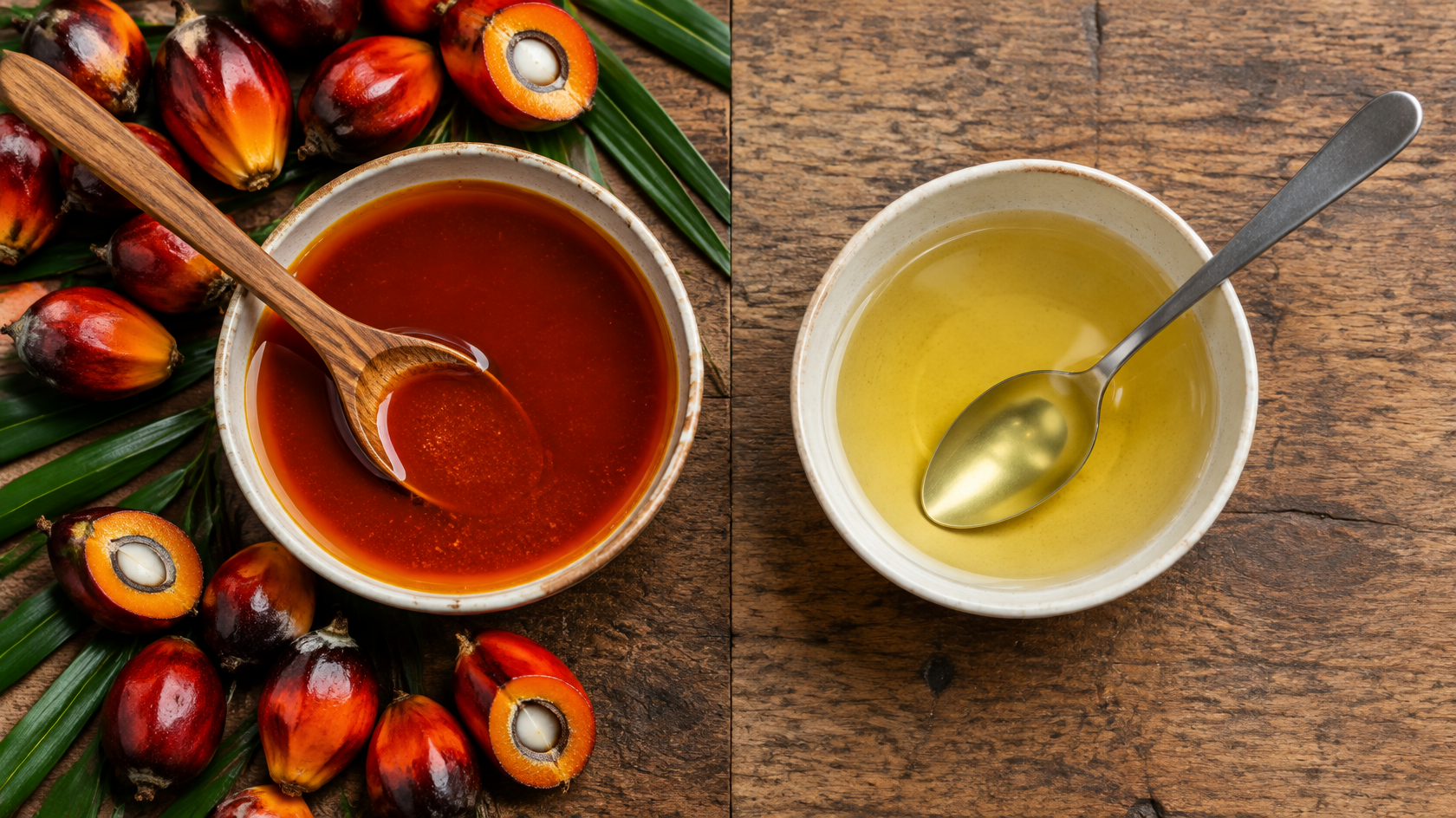
Quick answer: Red palm oil is unrefined or gently processed oil that keeps its natural carotenes, so it is deep orange-red with an earthy, savoury flavour. Refined palm oil (RBD) has been degummed, bleached with clay and deodorised with high-temperature steam, which strips out the colour, aroma and almost all the taste. For Nigerian and West African cooking, only red palm oil gives dishes their proper colour and flavour. Refined palm oil is a neutral frying fat and an ingredient in processed food.
Walk down the cooking oil aisle of a big supermarket and you might see “palm oil” that is pale yellow and odourless. Then open a bottle of Nigerian palm oil at home and it is a deep orange-red, smells of the fruit, and sets in the cold. Same tree, same fruit, completely different products.
The difference comes down to one thing: refining. In this guide I’ll explain what refining actually does, why there are really two kinds of “red” palm oil, and why African cooking depends on the unrefined kind. If you want the bigger picture on buying and storing it, our complete guide to Nigerian palm oil covers everything from sizes to storage.
OlaPantry is run by Olayinka, and it’s a UK-registered online African food store trading under Olakin Limited, Company Number 16909792, verifiable on the Companies House registry. We sell 100% natural, undiluted Nigerian palm oil, packed to UK food standards with a batch number on every bottle. In this guide you’ll find a simple checklist for telling real palm oil from fake or adulterated oil, from the smell and colour to the label and the seller behind it.
Tired of guessing what’s really in the bottle? Order genuine Nigerian palm oil from OlaPantry. It’s clearly labelled, fully traceable, and delivered to your door anywhere in the UK.
What is the difference between red palm oil and refined palm oil?
Red palm oil keeps the natural carotenoid pigments from the palm fruit, while refined palm oil has them removed along with its smell and most of its flavour. Both start as the same crude oil pressed from the fruit pulp. What happens next decides whether you end up with a bold cooking ingredient or a neutral industrial fat.
| Red (unrefined) palm oil | Refined (RBD) palm oil | |
|---|---|---|
| Colour | Deep orange to red | Light yellow |
| Flavour | Earthy, savoury, slightly fruity | Neutral, almost none |
| Aroma | Distinctive, nutty | Odourless |
| Processing | Boiled, pressed, skimmed and clarified | Degummed, bleached and deodorised |
| Carotenoids | Naturally present | Removed during bleaching and deodorising |
| Typical uses | Egusi, efo riro, ofada stew, native jollof, red red | Frying oil, margarine, shortening, biscuits, snacks |
| Where you find it | African grocers and specialist shops | Supermarket cooking oils and food ingredient lists |
If you take one thing from that table, make it the colour. The red is not decoration. It is the visible sign that the oil has not been refined.
How is refined palm oil made?
Refined palm oil is made in three industrial stages: degumming, bleaching and deodorising, which is where the name RBD (refined, bleached, deodorised) comes from. Each stage takes something out of the crude oil, and by the end the colour, smell and taste have all gone.
According to GAPKI, the Indonesian palm oil association, its explainer on RBD palm oil describes the process like this:
- Degumming. Phosphoric acid is added to remove gums and phosphatides from the crude oil.
- Bleaching. Activated bleaching earth, a type of clay, is mixed into the oil to absorb colour pigments, including carotenes and chlorophyll. The spent clay is then filtered out.
- Deodorising. Steam at high temperature strips out free fatty acids and the compounds that give the oil its smell.
The bleaching step is more literal than most people realise. Refiner Musim Mas explains in its guide to bleaching earth that the clay is typically added at 0.5 to 3% of the oil’s weight and worked through it under vacuum at 90 to 125°C. It removes the carotenoids that give crude palm oil its deep orange-red colour, along with chlorophyll and trace metals.
Deodorising finishes the job. The American Oil Chemists’ Society notes in its technical article on red palm oil that standard deodorising runs at 250 to 270°C, which “thermally degrades all carotenes” and leaves a light-coloured oil.
The refined oil is then often split into two fractions. GAPKI puts the typical split at about 73% olein, the liquid part sold as cooking oil, and 21% stearin, the solid part used in margarine and shortening.
How is traditional red palm oil made?
Traditional red palm oil is made by boiling fresh palm fruit, pounding it, washing the oil out with water, then skimming and gently heating it to drive off the water. There is no bleaching clay, no high-temperature steam and nothing added, so the natural pigments stay in the oil.
We walk through every stage, from fresh fruit bunch to bottle, in our guide to how natural palm oil is made. The short version is that the process stops where refining would begin.
That is why crude palm oil is so strongly coloured. The AOCS describes crude palm oil as the world’s richest natural plant source of carotenoids, and says its dark red colour comes from them. Traditional Nigerian palm oil keeps that colour because nothing has been done to remove it.
Is all red palm oil the same?
No. “Red palm oil” can mean two different products: traditional unrefined oil, like the Nigerian palm oil used in West African kitchens, or a commercially refined red palm oil made with a special low-temperature process. Both are red, but they are not interchangeable in the pot.
The second kind was developed in Malaysia. The AOCS explains that the crude oil is degummed, bleached and filtered, then deodorised by molecular distillation at under 170°C. Keeping the temperature low means up to 80% of the carotenes survive. The Malaysian Palm Oil Council’s page on Malaysian red palm oil gives the same 80% retention figure.
| Traditional Nigerian red palm oil | Commercial refined red palm oil | Refined (RBD) palm oil | |
|---|---|---|---|
| Processing | Boiled, pounded, skimmed, clarified | Degummed, bleached, molecular distillation | Degummed, bleached, deodorised |
| Deodorising temperature | None | Under 170°C | 250 to 270°C |
| Colour | Deep red | Red-orange | Light yellow |
| Flavour | Strong, earthy, savoury | Mild | Neutral |
| Carotenes kept | Not removed by refining | Up to 80% of crude oil levels | None |
| Best for | West African soups and stews | General cooking and frying | Frying, processed food |
The commercial version is red, but deodorising takes much of the earthy flavour with it. In a pot of egusi or efo riro, it will look right and taste a little hollow.
How do red and refined palm oil behave in the kitchen?
Red palm oil adds flavour and colour as it heats, while refined palm oil simply transfers heat without changing the taste of the food. That makes them suited to very different jobs.
Unrefined red palm oil is best over medium heat. It is the base of the dish, so you fry onions, peppers and spices in it and let its flavour carry through the pot. Push it too hard and it can burn, which turns the flavour bitter.
Refined palm oil is built for frying. With the free fatty acids and odour compounds stripped out, it behaves like any other neutral cooking oil, which is exactly why food manufacturers like it. The MPOC gives a smoke point of 232°C for its commercial refined red palm oil, a reminder that how an oil is processed changes how it handles heat.
Texture differs too. Whole palm oil is semi-solid at cool room temperatures, so a bottle of Nigerian red oil will thicken or set in a British kitchen in winter. Refined palm olein has had much of its solid fraction removed, so it stays liquid.
Why does African cooking call for unrefined red palm oil?
African cooking calls for unrefined red palm oil because the oil is an ingredient, not just a cooking medium. In dishes like egusi soup, efo riro, ofada stew and native jollof, the palm oil supplies the colour, the savoury depth and much of the aroma. Swap in a refined oil and the dish loses its character.
Think of it like the difference between cooking an Italian sauce with extra virgin olive oil or with a bland vegetable oil. Both will cook the onions. Only one tastes like the dish should.
There is one twist worth knowing. Ofada stew (ayamase) and ewa agoyin sauce use “bleached” palm oil, but that is not the same as industrial bleaching. At home, cooks heat red palm oil in a pot until the colour fades and it turns smoky. There is no clay and no deodorising, and the result has a deep, roasted flavour that refined oil could never give you. It has to start as unrefined red oil for that to work.
Can you use refined palm oil instead of red palm oil?
You can use refined palm oil for frying puff puff, plantain or akara, but not as a substitute in dishes where palm oil is the flavour. In egusi, efo riro or ofada stew, refined oil gives you the wrong colour and none of the taste.
If you cannot get red palm oil, no neutral oil will truly replace it. The better answer is to keep a bottle of the real thing in the cupboard.
How can you tell which kind of palm oil you are buying?
You can tell which kind you are buying from the colour and the label. Deep red oil that thickens in the cold is unrefined. Pale yellow, liquid oil labelled “palm olein”, “refined palm oil” or simply “vegetable oil (palm)” is refined. And if a red oil stays completely runny right through a cold British winter, be cautious, because it may have been blended with a cheaper liquid oil.
The label should also tell you the country of origin, a best-before date and a batch number. Every OlaPantry bottle carries those details, as set out on our food safety and labelling page. Behind them is a business you can check: OlaPantry is a trading name of OLAKIN LIMITED (company number 16909792), and our food business is registered with Huntingdonshire District Council and Cambridgeshire County Council under reference KHE1HR-5D8PNK-N7HDBD. You can read more about who we are on our site.
Which should you buy?
If you are cooking Nigerian or West African food, buy unrefined red palm oil. Keep refined oil for deep frying and baking, where you want no flavour at all. Commercial refined red palm oil sits in the middle: red and mild, but missing the depth that traditional dishes need.
At OlaPantry we sell only the first kind. Our unrefined Nigerian red palm oil comes in 1L, 2L and 5L bottles, from £5.99, with nothing blended in and no colouring added.
The bottom line
Red and refined palm oil start life as the same fruit, but refining takes away everything that makes palm oil worth cooking with: the colour, the aroma and the flavour. Commercial red palm oil keeps some of it. Traditional unrefined oil keeps all of it, which is why West African cooks have always reached for it.
When you are ready to cook with the real thing, visit the OlaPantry shop and pick the size that suits your kitchen.